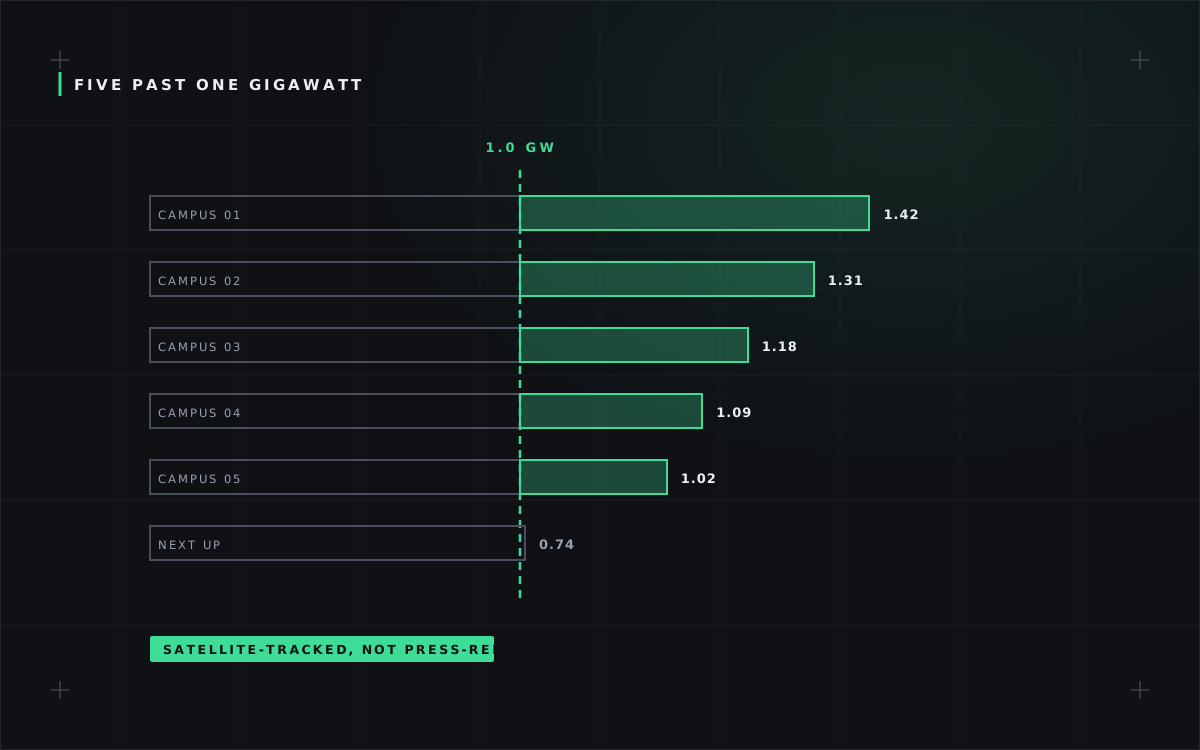
Brief: the gigawatt data centre stopped being a rendering this year. Independent tracking counts five campuses at or past one gigawatt of power in 2026 - one each from Amazon, Microsoft, xAI, Meta and OpenAI’s Stargate - and, for the first time, there is enough public evidence to score the two competing construction philosophies against each other. The scoreboard follows; the surprise is how clearly it reads.
5Campuses at ≥1 GW in 2026, per Epoch AI tracking
$9-11BPer gigawatt, grid-connected powered shell
$19.2BPer gigawatt with on-site gas, per Crusoe’s CEO
120-200 kWPer rack, current to next-gen AI systems
The result: grid power won the race it wasn’t supposed to win
The Stargate thesis was speed through self-supply: skip the interconnection queue, install aeroderivative turbines - jet engines, effectively; the flagship Abilene site ordered 29 of them - and outrun everyone. The satellite record says otherwise. Cleanview’s analysis, covered by the Times, the Journal and Bloomberg, found the Amazon-built campus in New Carlisle, Indiana - Anthropic’s training site - was first past one gigawatt, in March 2026, on grid power, with roughly five times Stargate’s energised capacity at that date. Abilene’s third and fourth buildings, permitted to finish in March, were still not online in June per the developer’s own releases. And the costs inverted the pitch: about $9-11 billion per gigawatt for a grid-connected shell against $19.2 billion with the gas plants counted - the behind-the-meter premium, stated to Stanford students by the CEO who paid it. This desk covers AI companies including the one above without favour; the numbers here are the satellite analyst’s and the builders’ own.
The bill is arriving on residential meters
The externality line hardened this year too. Data centres accounted for an estimated $9.3 billion of the 2025-26 PJM capacity-price increase - roughly $18 a month on bills in western Maryland, $16 in Ohio - and a January Jefferies note to investors declared the “data centre honeymoon over,” the industry recast as villain in an energy-affordability election year. The policy response is structural: Virginia’s regulator approved a dedicated rate class in November requiring large loads to pay for at least 85% of contracted capacity whether used or not, and Michigan’s commission attached its 3-0 approval of a 19-year, 1.4-gigawatt Stargate supply deal to conditions, over local opposition vivid enough to make national wires. Take-or-pay tariffs and contested sitings are now part of the unit economics.
THE RATIO TO CARRY AROUND
The IEA projects a single advanced AI rack will draw peak power equivalent to about 65 households by 2027, after an eleven-fold density rise since 2020. Multiply by tens of thousands of racks per campus and every number above stops being surprising - including the McKinsey estimate of $5.2 trillion in data-centre investment needed by 2030 for ~156 GW of AI capacity.
Reading the next announcement
The 2026 scorecard rewrites this desk’s standing manual in one respect: “behind-the-meter” is no longer automatically the fast lane. It bought Abilene an early start and then met turbine lead times, novel-plant integration and a 2× capital premium; meanwhile a patient interconnection agreement in Indiana quietly delivered the milestone. The reading rule that survives: score announcements on energised megawatts, dated, and price them per gigawatt including power - the two disclosures that separated winners from renderings this year.
THE NUMBERS THAT MATTER
- 1 GW, March 2026 - first campus past the line, grid-connected, per satellite analysis.
- $9-11B vs $19.2B - per-gigawatt cost, grid shell vs gas-backed. The premium is the story.
- $9.3B / +$18 a month - PJM capacity-cost attribution and the household translation.
- 85% take-or-pay - Virginia’s new large-load rate class; the template other states are reading.