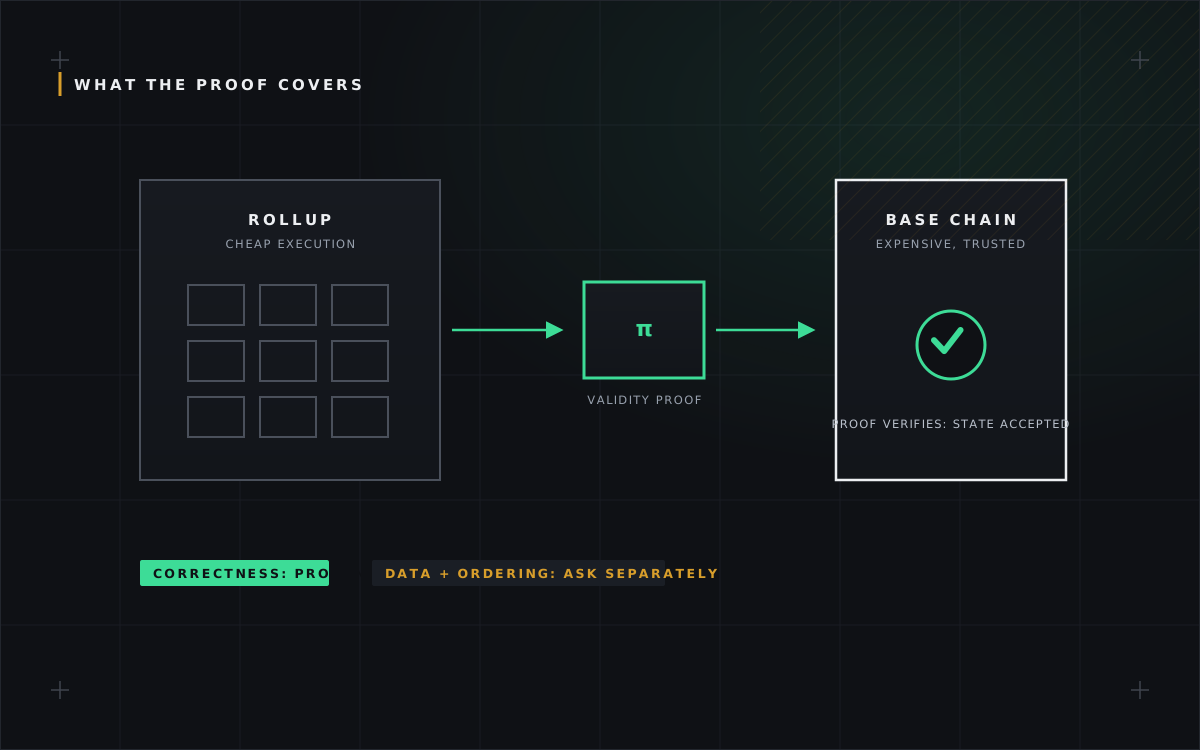
A rollup executes transactions somewhere cheap and posts the results to a blockchain that is expensive but trusted. The interesting question - the one the marketing rarely answers precisely - is what, exactly, the base chain ends up guaranteeing.
There are two answers, because there are two families. A validity rollup (often called a ZK rollup) posts a cryptographic proof alongside each batch: a succinct certificate that every transaction in the batch was executed correctly according to the rules. The base chain checks the proof before accepting the new state. An optimistic rollup posts the results with no proof at all, and instead opens a challenge window - typically days - during which anyone can submit a fraud proof showing the operator cheated. Validity systems prove honesty up front; optimistic systems make dishonesty punishable after the fact.
| Validity (ZK) rollups | Optimistic rollups | |
|---|---|---|
| What is posted | New state plus a validity proof | New state, no proof |
| When it’s final | Once the proof verifies on the base chain | After the challenge window passes |
| Trust assumption | The proof system’s cryptography | At least one honest, watching challenger |
| Typical cost profile | Heavy proving off-chain, cheap verification on-chain | Cheap by default, expensive only in disputes |
What the proof covers
In a validity rollup, the proof covers state transition correctness: given the previous state and this batch of transactions, the new state is the one the rules produce. That is a genuinely strong guarantee - the operator cannot invent balances or forge signatures, because no valid proof would exist for such a batch.
What it doesn’t
Two things sit outside the proof, and they are where diligence belongs. The first is data availability: a proof shows the new state is correct, but if the underlying transaction data isn’t published somewhere retrievable, users may be unable to reconstruct their own balances and exit. Where that data lives - on the base chain, or somewhere cheaper with its own trust assumptions - varies by system and changes the guarantee materially. The second is the sequencer: most rollups today rely on a single operator to order transactions. A proof prevents that operator from executing your transaction incorrectly; it does not prevent them from delaying it, reordering it profitably, or refusing it entirely. Censorship-resistance and correctness are different properties, and only one of them is in the proof.
So when a project says it inherits the base chain’s security, the checkable translation is: correctness is proven, and then two follow-up questions - where does the data live, and who controls ordering. The answers are usually public. They are just rarely in the headline.
Data availability: the quiet fork in the road
Where the transaction data lives has quietly become the axis on which the whole category splits. Post it to the base chain and users inherit its full guarantee - anyone can reconstruct the rollup’s state from public data alone, forever. The base chain even grew a dedicated lane for this: a cheaper class of temporary data storage introduced specifically so rollups could publish in bulk without competing with ordinary transactions for space. Post the data somewhere else - a committee, a separate network with its own token - and fees drop dramatically, but the guarantee changes species: now users are trusting that the external system will keep the data retrievable, and a chain whose data vanishes is a chain whose balances are opinions. The industry politely distinguishes these as rollups versus “validiums” and their cousins; marketing rarely does. The one-line test: if the data host disappears tomorrow, can I still prove what I own?
Exit rights
The final property worth demanding is the unglamorous one: a forced exit. A well-built rollup lets any user withdraw to the base chain using only public data and their own keys, even if the operator is offline, hostile, or gone - the design goal that separates “secured by” from “custodied near”. Whether that path exists, whether it has ever been exercised, and how long it takes under congestion are documented, checkable facts for every serious system. They belong in coverage of any rollup, and in due diligence before any deposit.
Mar 2024Blobs live - Dencun cut rollup data costs
<10 szkVMs now prove 99% of L1 blocks - the 2025 milestone
Where the proving frontier moved
Two dates re-drew this landscape. In March 2024 the Dencun upgrade gave rollups blob space - dedicated, cheap data availability - and per-transaction costs on major rollups fell by an order of magnitude overnight. And through 2025 the proving stack itself crossed a line nobody expected so soon: latency for proving full Ethereum blocks fell from around sixteen minutes to sixteen seconds, costs dropped roughly forty-five-fold, and by year-end multiple independent zkVMs were proving 99% of mainnet blocks in under ten seconds - fast enough that the Ethereum Foundation’s 2026 roadmap now treats validity proofs as the base layer’s own future validation mechanism, not just the rollups’. The verification hierarchy this piece describes is, in other words, migrating downward into the protocol itself.
WHAT WE’RE WATCHING
- Proof-system security margins - the EF’s 2026 target: 128-bit provable security at ≤300KB proofs.
- Stage-2 rollup graduations - training wheels off, upgrade keys burned, exits trust-minimised.
- The sequencer question - decentralising the one box in the diagram users still just trust.
The Blockchain Desk covers markets because markets are where these systems are tested. Nothing on this desk is investment advice, and The Verifier holds no positions in the assets it covers.