Every blockchain pitch eventually arrives at the word immutable. It is doing three jobs at once - and only one of them is fully true.
Finality is probabilistic, then social
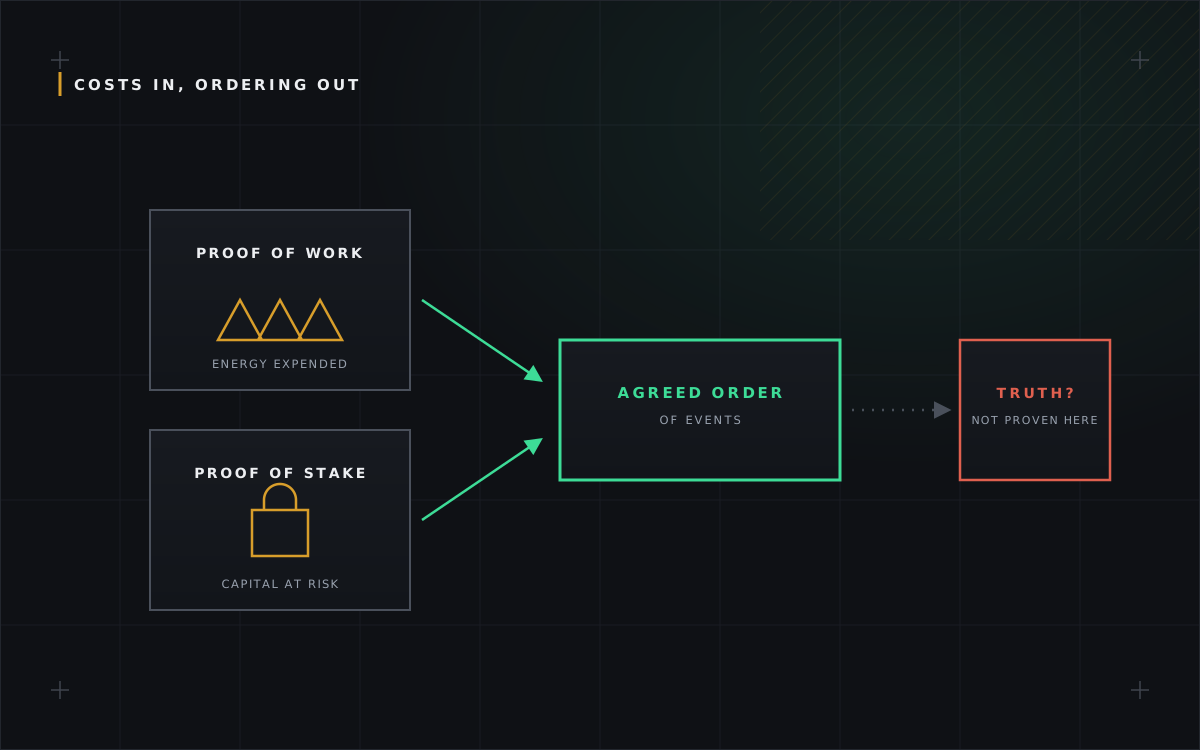
In proof-of-work systems, a transaction’s permanence grows with the blocks built on top of it: rewriting history requires redoing that work faster than the honest network extends it. That makes reversal exponentially expensive, not impossible - which is why exchanges wait for confirmations. Modern proof-of-stake designs add explicit finality checkpoints, which strengthen the guarantee but move its foundation: finality now rests on the assumption that a supermajority of staked validators won’t coordinate to violate it, with severe financial penalties if they do.
And above the protocol sits the social layer. In 2016, after a major theft from a prominent smart contract, the Ethereum community chose to fork the chain and unwind the damage - the minority who disagreed continued the original chain as Ethereum Classic. The episode is the cleanest demonstration on record that a blockchain’s history is ultimately maintained by the people who choose to run it.
The record is not the truth
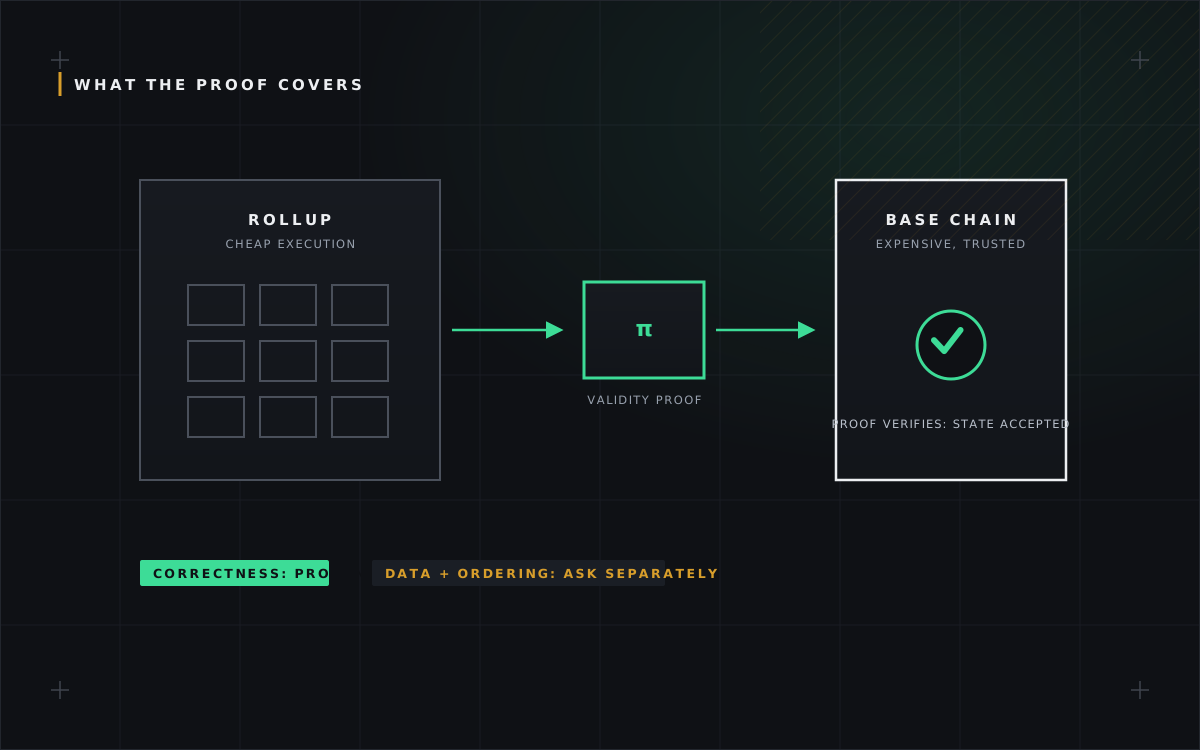
There is a second, quieter confusion: immutability of the record gets marketed as reliability of the contents. A chain guarantees that what was written stays written and stays ordered. It cannot make a false statement true. If an oracle reports the wrong price, or a registry entry was fraudulent at the moment of writing, the chain will preserve that error with perfect fidelity forever. Garbage in, garbage immutable.
What survives the correction
None of this makes the property worthless - the opposite. A ledger that can only be rewritten in public, at enormous cost, by visible coordination, is a genuinely new kind of record. The honest claim is not “this can never change” but “this cannot change quietly.” For a publication built on the idea that changes to the record should be visible, that is the version of immutability worth having - and the only one on offer.
Finality shopping: what the professionals do
Institutions that move real value have already priced all of this, and their behaviour is the best documentation of what “immutable” means in practice. Exchanges publish confirmation requirements per asset - more blocks for chains that reorganise more easily, fewer for chains with explicit finality - and raise them when a network’s hashrate drops or an attack rumour circulates. Custodians distinguish “included” from “final” in their legal language. None of them treats a fresh transaction as settled, because none of them confuses a probability with a promise. A reader can borrow the heuristic wholesale: the permanence of a blockchain record is whatever the most paranoid professional counterparty demands before acting on it.
Reading an immutability claim
When the word appears in a pitch, four questions convert it to engineering. What is the reorganisation model - probabilistic depth, or explicit finality checkpoints? What has to fail, and at what cost, for history to rewrite? Has this chain ever reorganised or forked contentiously, and how was it handled? And - the one the pitch never volunteers - what does immutability of the record do for data that was wrong when written? A system that answers all four is making a claim; one that repeats the adjective is making a sound.
The property that survives scrutiny
Strip the marketing and a precise, defensible claim remains, worth stating because it is what the technology actually sells. A well-run public chain gives you a record whose alteration is detectable by anyone, expensive for everyone, and impossible to do selectively in secret. Detectable, because every participant holds the history and any rewrite forks visibly from it. Expensive, because the rewrite must outrun or out-vote the honest network under the consensus arithmetic. And never selective-in-secret, because you cannot alter one entry without recomputing everything above it in front of the world. That triad - not permanence - is the honest product, and it is genuinely novel: no prior public record made tampering this loud. Coverage that uses the property precisely tends to be coverage you can trust about the rest.
Immutability was never a property of the data. It was always a property of the incentives - and incentives have exchange rates.
The honest restatement
So the claim worth defending is narrower and stronger than the slogan: on a sufficiently valuable chain, rewriting history costs more than the rewrite is worth, and the cost is public. That is not “cannot be changed.” It is “cannot be changed quietly, or cheaply” - which, for a financial record, is the property that actually matters. Chains with thin security budgets have been reorganised for profit before and will be again; the desk’s working rule is that immutability scales with the attack’s price tag, and the price tag is checkable.
WHAT WE’RE WATCHING
- Security-budget ratios on smaller proof-of-work chains - where reorg economics pencil first.
- Social-layer interventions - any future fork that edits history by consensus rather than attack.
The Blockchain Desk covers markets because markets are where these systems are tested. Nothing on this desk is investment advice, and The Verifier holds no positions in the assets it covers.