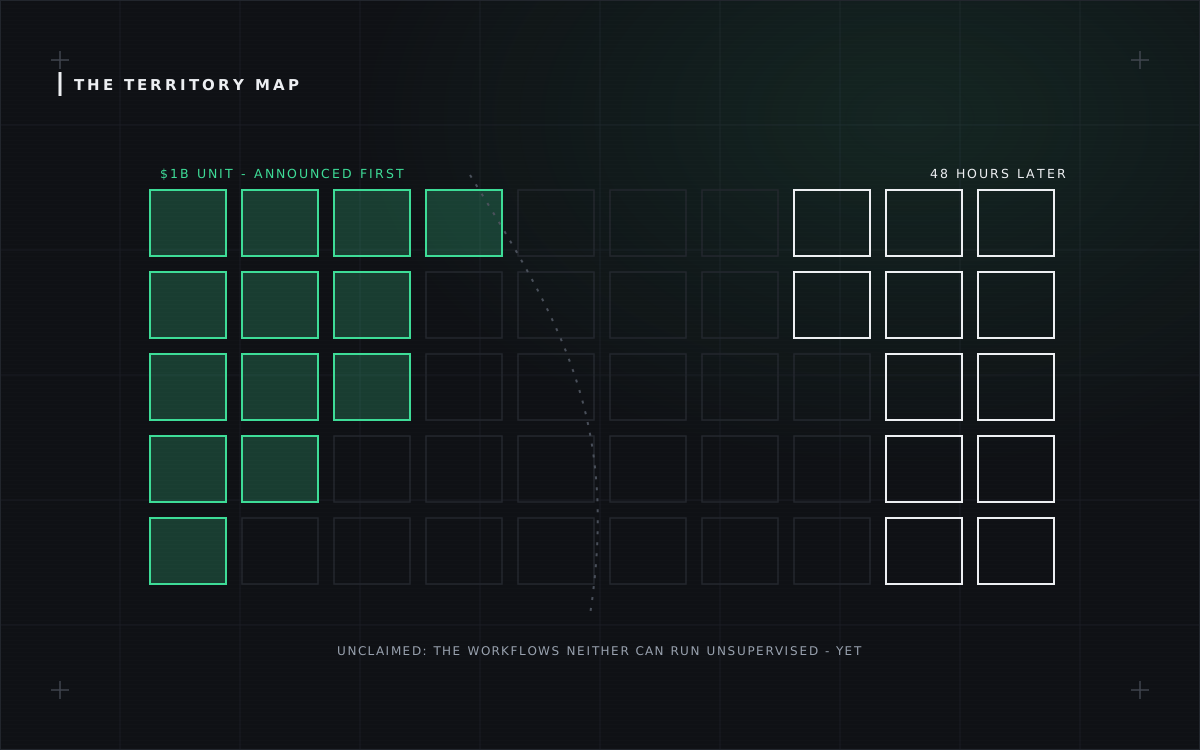
In one week: Amazon unveiled a $1 billion AWS engineering unit that embeds humans inside customer teams to deploy agents; two days later, on 2 July, Microsoft launched “Microsoft Frontier Company” - $2.5 billion, six thousand experts, Unilever and Novo Nordisk as first customers. If the name sounds familiar, it should: OpenAI shipped its enterprise agent platform, called simply Frontier, in February, with HP, Intuit, Oracle, State Farm and Uber aboard. Three giants, $3.5 billion of announced spend, one contested word. This column is about what the spending pattern verifies.
The tell: they’re hiring humans
Read the announcements as evidence rather than marketing and one fact leaps out - the products are made of people. Six thousand embedded experts. Forward-deployed engineers. “Change management and continuous improvement experience.” The companies with the best models on Earth are spending billions on consultancies, which is the most credible statement anyone has made this year about the gap between model capability and deployed value. OpenAI’s own launch language conceded it: as agents improved, “the opportunity gap between what models can do and what teams can actually deploy has grown.” That sentence, from the vendor, is worth a dozen keynote demos.
When the model companies start selling implementation, the constraint has been located - and it is not the model.
What’s actually being fought over
Underneath the naming collision, the strategies differ in one checkable way. OpenAI’s Frontier is a platform - shared business context, permissions, onboarding for agents, pointedly open to agents built elsewhere. Microsoft’s is an operating business - a services army, explicitly multi-model. Amazon’s is engineering capacity attached to the cloud bill. All three are bids to own the same asset: the layer where an enterprise’s agents get their context, credentials and boundaries. That layer, as commentators noted within hours of the OpenAI launch, is also the deepest lock-in ever offered - tethering workflow infrastructure to a model vendor in the fastest-moving market in software. The counter-position writes itself, and the discussion threads wrote it: keep the control plane neutral, keep the models swappable.
The verifiable questions, as ever
Vendor claims in this category arrive as outcome anecdotes - a six-week process to one day, ninety percent of a salesforce’s time reclaimed, five percent more output at an energy producer. Every one is unverifiable as published: no baselines, no methodology, no counting rules. So this desk will grade the agent-platform war on disclosures that can be checked instead: named deployments with defined task boundaries; what each agent is permitted to do unattended (our standing four-question audit applies); incident and rollback disclosures; and renewal behaviour - whether the launch customers are still customers in a year. The billions are real and dated. The value claims are, so far, neither.
THE DESK’S BOTTOM LINE
A $3.5 billion week tells the truth sideways: deployment, not capability, is the bottleneck, and everyone with a frontier model is now selling ladders into the gap. Judge the platforms on permissioned autonomy and published incident behaviour - the two things no launch post has yet contained.