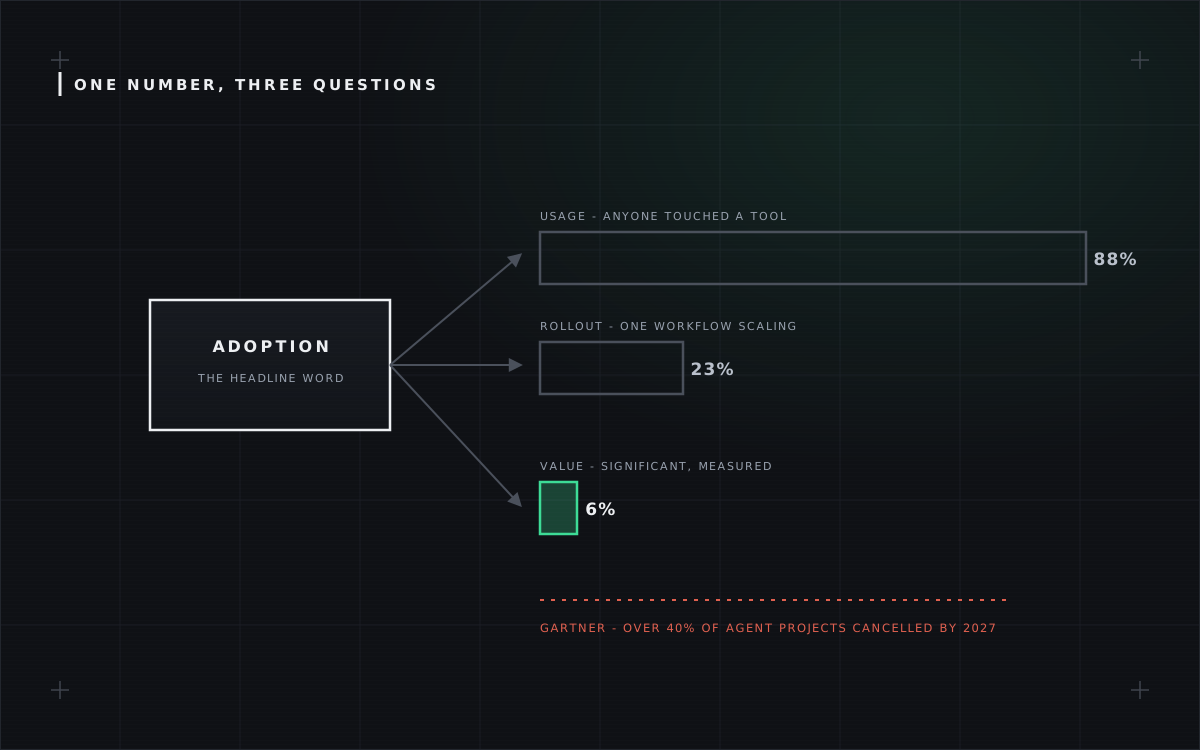
Here is the 2026 enterprise-AI discourse in three statistics that circulate in the same slide decks: roughly four in five companies say they are adopting AI agents; roughly one in twenty organisations, by McKinsey’s accounting, captures significant enterprise value from AI; and Gartner projects that more than 40% of agentic AI projects will be cancelled by the end of 2027. These cannot all describe the same reality - unless you notice that no two of them measure the same thing, which is precisely the case. This desk’s benchmark rules apply to adoption statistics too, and it is time someone applied them.
Three questions before any adoption number
What is being measured, who was surveyed, and does the figure describe usage, rollout, or outcome? Run the famous numbers through that filter and the fog organises itself. “88% of organisations use AI” measures whether anyone, anywhere in the org touched a tool - a bar a single enthusiastic intern clears. “23% are scaling an agentic system” (McKinsey) measures rollout of one workflow. “Only 25% of initiatives delivered expected ROI” (IBM’s CEO survey) measures outcomes against promises - a different denominator entirely. And the widely quoted failure rates of “80-95% of AI projects” span fifteen points because they blend P&L impact studies with delivered-value studies that were never comparable. None of these numbers is fake. Each is answering a question the headline didn’t ask.
<5% → 40%Share of enterprise apps with task agents, 2025 → end-2026 (Gartner projection)
~6%Organisations capturing significant value from AI (McKinsey)
>40%Agentic projects Gartner expects cancelled by end-2027
The tell in the incentives
Adoption statistics are produced by three parties: consultancies selling transformation, vendors selling platforms, and buyers justifying budgets. All three are rewarded for the largest defensible number, which is why “experimenting with” so reliably becomes “adopting” by the second slide. The cleanest recent signal is behavioural rather than surveyed: in February 2026 Meta began formally tying employee performance reviews to AI usage - companies bet compensation only on things they believe are real. And the cancellation projection deserves its own respect: Gartner’s 40%-cancelled figure is the rare statistic produced against its audience’s enthusiasm, which in this desk’s experience is the property most correlated with being right.
THE SENTENCE THAT WOULD ACTUALLY INFORM
“N agents run in production, executing X% of [named workflow] end-to-end, with an intervention rate of Y and a measured cost delta of Z against the prior process.” Any organisation that has this sentence publishes it. The absence of the sentence, in a market this loud, is itself a datum.
The desk’s reading
Something real is happening - production deployments exist, the tooling matured fast, and serious money is being rebudgeted. But the distance between the 79% and the 6% is not a contradiction; it is the standard shape of every enterprise technology cycle, measured mid-slope by parties with quotas. Price each number by its question, and the 2026 picture becomes legible: broad shallow contact, narrow deep value, and a culling ahead that the most-quoted forecaster has already scheduled.
THE DESK’S BOTTOM LINE
An adoption statistic is a benchmark wearing a suit: check the task, the denominator, and who paid, and treat “uses AI” the way you’d treat “passed one unit test.” The honest 2026 summary fits in a line - contact is near-universal, value is rare and concentrated, and both facts are simultaneously true.