Follow the money in crypto for long enough and it stops being crypto: it becomes dollars, wearing a token as a coat. Stablecoins settled more than $33 trillion on-chain in 2025 - past Visa’s annual network volume - and reached a record $322 billion in circulation in June 2026. This desk’s brief covers how the three designs actually hold a dollar, the forensic record of the one that didn’t, and the year regulation stopped being hypothetical.
$322BRecord market cap, June 2026
$33TOn-chain volume 2025 - above Visa
~$127BOne issuer’s US Treasury holdings - sovereign-scale
$7BTokenised Treasury funds, led by BUIDL
Three ways to hold a peg
| Design | How the peg holds | What you are actually trusting |
|---|---|---|
| Fiat-backed | Issuer holds cash and short-term Treasuries per token; redeems on demand | The issuer’s solvency, its banks, and the honesty of reserve reporting |
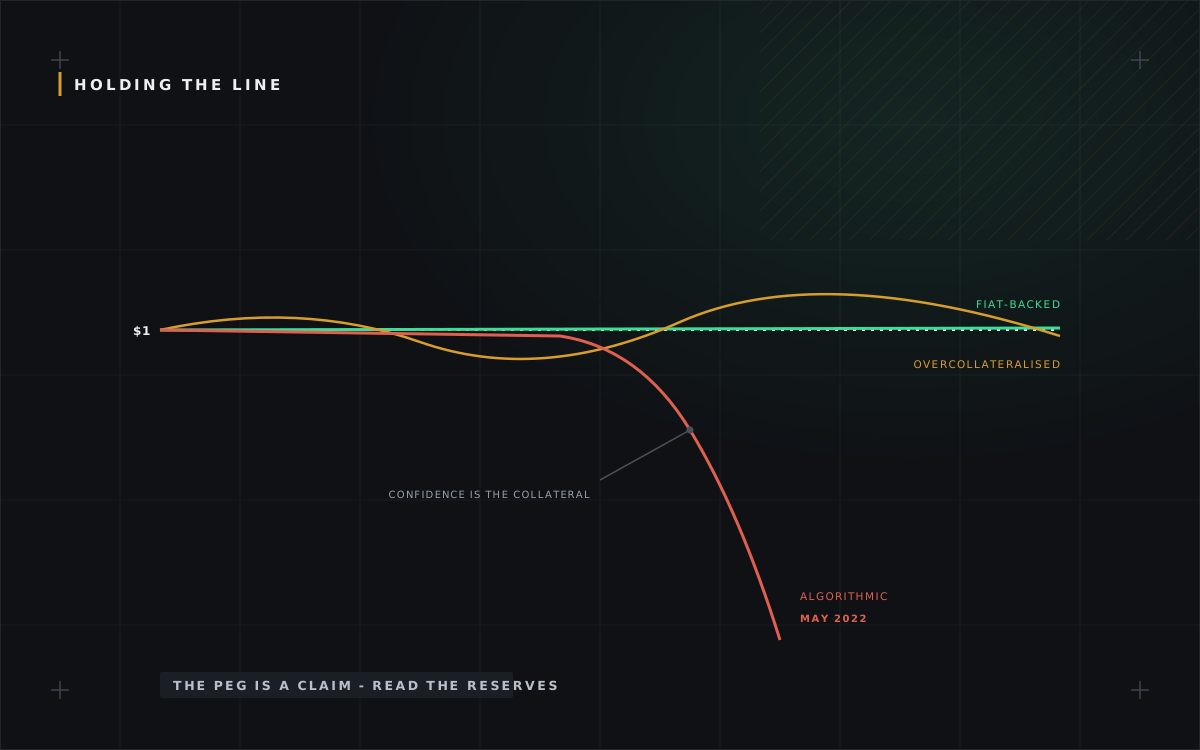
| Overcollateralised | Contracts hold >$1 of volatile collateral per token; liquidations defend the line | The code, the price oracles, and collateral falling slower than liquidations run |
| Algorithmic | No full backing; a sister asset is minted and burned to absorb demand | Perpetual market confidence in the mechanism itself |
The forensic record: how the third design died
Terra’s UST was, in April 2022, the third-largest stablecoin at roughly $17.5 billion, three-quarters of it parked in the Anchor protocol earning a 19.5% yield that Terraform was subsidising at about $6 million a day. The run began on 7 May 2022 with large withdrawals from Anchor; by 9 May, 5 billion UST left the protocol in a single day; the peg’s defence mechanism - mint LUNA to absorb redemptions - flooded a collapsing asset with supply, and LUNA fell from a $119 April peak to effectively zero by 13 May. The Luna Foundation Guard deployed a reserve of 80,394 bitcoin against the run and failed. Total destruction: roughly $40-45 billion in days, contagion into Celsius and Three Arrows behind it. The legal system’s verdict arrived on schedule: Terraform settled with the SEC for $4.47 billion, and in December 2025 Do Kwon was sentenced to fifteen years after pleading guilty to fraud. The design lesson costs nothing to state and cost $40 billion to demonstrate: a peg backed by confidence alone is a bank run with better branding.
2025-26: the year the statutes arrived
Two regimes now define the map. In Washington, the GENIUS Act - Public Law 119-27, signed 18 July 2025 - made payment stablecoins a licensed federal category: permitted issuers only, 1:1 high-quality reserves, and no yield paid to holders, with OCC implementation rules proposed in March 2026 and the full regime targeted at 2027. In Brussels, MiCA’s transition ended on 1 July 2026 with the largest delisting wave in European history: the biggest stablecoin’s issuer declined the e-money licence, so Coinbase, Kraken, Crypto.com and Binance’s EU arm removed or restricted it for European users, while Circle - holding a French e-money licence passported across the bloc - inherited the regulated market. The instructive detail is what did not happen: global supply of the delisted coin hit an all-time high near $160 billion in the same quarter. Europe regulated its venues; it did not regulate the world.
READING A RESERVE REPORT LIKE AN ADULT
An attestation is an accountant confirming a snapshot existed; an audit is an opinion on controls over a period - the industry publishes far more of the former. The composition line outranks the total: Treasuries and cash redeem in a crisis; loans to affiliates and “other investments” are where past troubles lived. Both new regimes turn this from analyst hygiene into legal obligation.
Why any of this matters outside trading
Because the payment properties are real and now sovereign-scale in their side effects. Final settlement in seconds at any hour; remittances and supplier payments over rails the banking day does not govern; dollar savings in high-inflation economies - and, on the other side of the ledger, issuers who have become structural buyers at the front of the Treasury curve, with the largest holding roughly $113-127 billion in Treasuries across 2024-25, a position in the range of the eighteenth-largest sovereign holder. A stablecoin is not new money. It is a new interface to old money - and interfaces get judged on uptime, honesty and exits, which is precisely how this desk grades them.
WHAT WE’RE WATCHING
- OCC final rules (targeted July 2026) - whether GENIUS reaches offshore issuers serving US users.
- The no-yield boundary - yield-bearing wrappers drove over half of 2026’s growth; regulators have noticed.
- Bank consortium coins - 140-partner Open USD and Europe’s bank-built euro tokens, the incumbents’ counter-attack.
- The next reserve stress - 1:1 backing is necessary, not sufficient; the run risk moved to market plumbing.
The Blockchain Desk covers markets because markets are where these systems are tested. Nothing on this desk is investment advice, and The Verifier holds no positions in the assets it covers.