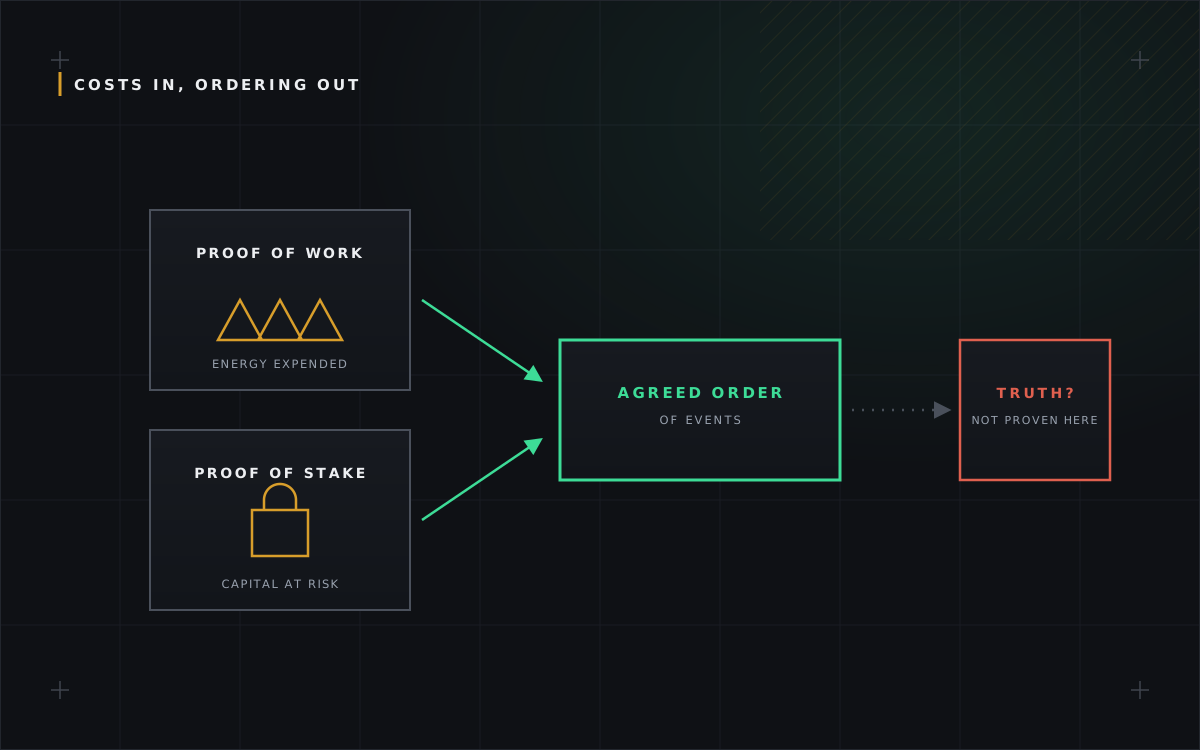
Consensus mechanisms are named like proofs, which invites a category error: the belief that they prove something about the world. They don’t. Each one proves something about the participants - and uses it to solve one narrow, hard problem: getting strangers to agree on the order of events.
| Mechanism | What is proven | Why it works |
|---|---|---|
| Proof of work | Real energy and hardware were expended on this history | Rewriting history means redoing the work, faster than everyone else combined |
| Proof of stake | Value is locked and slashable behind this history | Attacking the chain destroys the attacker’s own capital |
| Proof of authority | Named, accountable parties signed this history | Reputation and legal exposure replace anonymous economics |
Notice what every row has in common: the thing proven is a cost. Consensus works by making dishonesty more expensive than honesty, under stated assumptions about how much of the network an attacker can control. Change the cost structure and you change the security - which is why “which consensus is best” has no general answer, only trade-offs against threat models.
The thing none of them prove
No consensus mechanism can prove that a statement about the outside world is true. The chain can order the claim “the temperature was 30 degrees” irreversibly; it cannot check a thermometer. Every application that depends on external facts - prices, deliveries, identities, sensor readings - imports its truth from oracles, and inherits their trust assumptions wholesale. When you evaluate any on-chain system, the first question is never the consensus algorithm. It is: where does this system’s truth come from, and who could lie to it?
The majority arithmetic
Every mechanism in the table shares one silent clause: as long as a majority of the costly resource is honest. Cross that line and the guarantees invert. A miner coalition with most of the hashpower can rewrite recent history and censor at will; a cartel with a supermajority of stake can finalise whatever it likes, subject to burning its own capital. What keeps systems safe is not that attacks are impossible but that the resource is expensive and dispersed - which is why the honest health metrics of any chain are boring supply-side numbers: how concentrated is the hashpower or stake, how expensive would a majority be to rent or buy, and how would the community respond if it happened. Small chains fail this arithmetic routinely, and majority attacks on minor networks are a recurring, documented genre rather than a hypothetical.
Reading a consensus pitch
New mechanisms arrive weekly, each with a proof-of-something name. The evaluation template is stable: What is the costly thing, and can its cost be measured? Who can become a validator, and what does the current concentration look like? What exactly happens to an attacker - lost energy, slashed stake, a lawsuit? And what does the mechanism assume about the outside world - clocks, network delays, honest majorities of a committee? A whitepaper that answers those in numbers is engineering. One that answers in adjectives is a token sale.
The names that follow the pattern - and the ones that don’t
Once you hold the cost lens, the zoo of proof-of-X names sorts quickly. Proof-of-space commits disk instead of energy; delegated variants trade validator openness for speed by electing a small committee, importing committee politics as the price; proof-of-history, despite the name, is not a consensus mechanism at all but a verifiable clock other machinery leans on. Then there is the family the lens exposes rather than sorts: mechanisms whose “cost” is the project’s own token, distributed by the project, to insiders. The circularity is the finding - security denominated in an asset the security is meant to protect is a bootstrap, defensible only once the asset has independent, dispersed value, and an evaluation that skips that question has skipped the mechanism.
THE ONE-LINE TEST
Every consensus mechanism answers the same question - what is expensive to fake? - with a different resource. Read any new “proof-of-X” by asking what X costs an attacker, who already owns lots of X, and what happens to X’s price if the chain succeeds. Most whitepaper novelty dissolves under those three questions.
WHAT WE’RE WATCHING
- Stake concentration - liquid-staking and exchange share of major proof-of-stake networks.
- Post-quantum consensus work - hash-based signature migrations moving from papers to roadmaps.
The Blockchain Desk covers markets because markets are where these systems are tested. Nothing on this desk is investment advice, and The Verifier holds no positions in the assets it covers.