When a lab releases a model’s weights for download, headlines reliably call the model open source. The label imports fifty years of goodwill from software - inspectability, reproducibility, freedom to modify - much of which does not transfer.
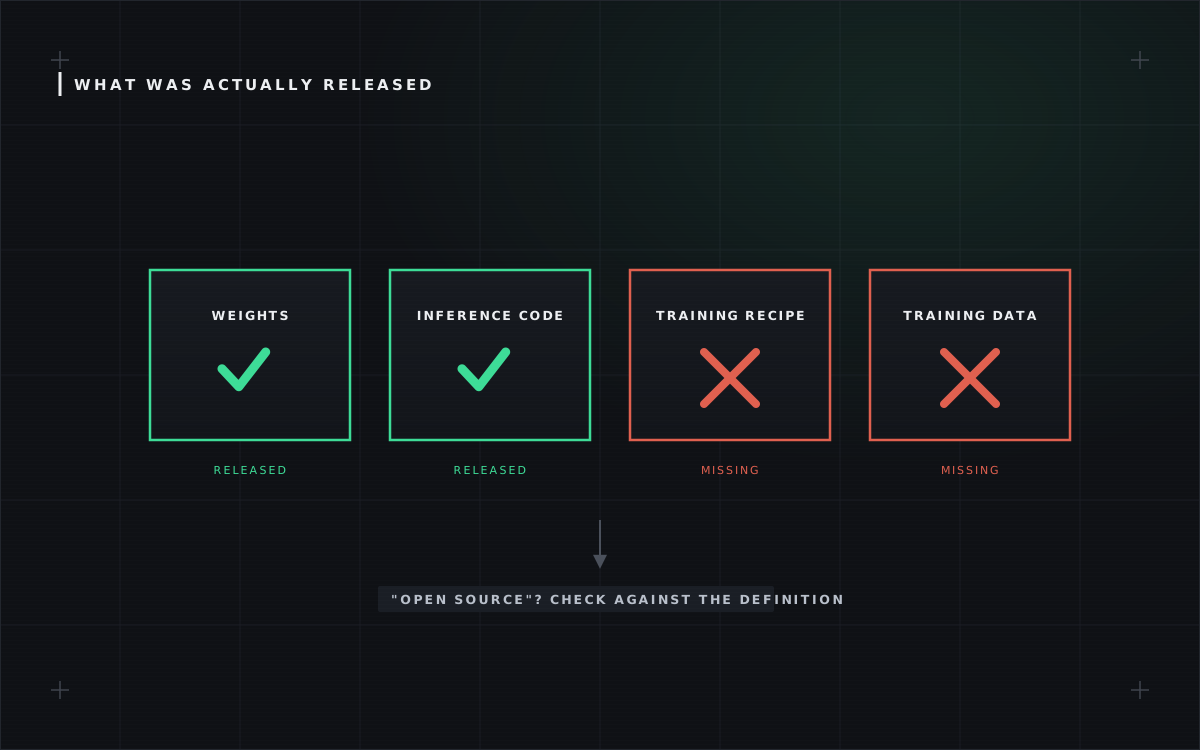
Weights are the output of training: hundreds of gigabytes of numbers. Releasing them is genuinely valuable - anyone can run the model locally, fine-tune it, study its behaviour and build on it without permission. But weights alone are closer to a compiled binary than to source code. You can execute and even patch a binary; you cannot see how it was made, audit what went into it, or rebuild it yourself.
| Component | Typically released as “open” | Needed to study or reproduce the system |
|---|---|---|
| Weights | Usually yes | Yes |
| Inference code | Usually yes | Yes |
| Training code & recipe | Rarely | Yes |
| Training data (or a detailed account of it) | Almost never | Yes |
| Licence without use restrictions | Sometimes - many carry commercial or behavioural limits | Yes, under the classic definition |
There is now a yardstick
This is no longer just a terminology quarrel. The Open Source Initiative - the body that has stewarded the definition of open source software for decades - published an Open Source AI Definition, and it requires more than weights: the code, the parameters, and sufficiently detailed information about the training data for a skilled person to substantially recreate the system, all under terms that permit use, study, modification and sharing for any purpose. Most released models marketed as open source do not meet it, most commonly on the data requirement or on licence restrictions.
None of this makes weight releases bad - they have moved the field and put capable models in independent hands. The point is precision, which is this publication’s entire business: open weights tells you what you can download. Open source is a checkable claim against a published definition. When the two are swapped, something specific is being obscured - usually the data.
Why the data clause is the hard one
Of the definition’s requirements, training-data transparency is the one the industry most conspicuously fails, and the reasons are structural rather than shy. Corpora are assembled from scraped web text whose copyright status is actively litigated in multiple jurisdictions - itemising sources is discovery material. Licensed datasets carry contracts that forbid disclosure. Competitive advantage increasingly lives in data curation rather than architecture, so the recipe is the moat. And at frontier scale nobody can fully audit what billions of documents contain, so a truly “detailed account” is partly a promise about the unknowable. None of this excuses the label-stretching; it explains why the gap persists and why the definition’s authors drew the line where openness is hardest - because that is exactly where the word was doing the most unearned work.
A reader’s checklist
When the next “open source model” headline arrives, four checks take two minutes. Read the licence for use restrictions - commercial caps, behavioural clauses, revocation rights all disqualify under the classic meaning. Look for training code and the recipe, not just inference scripts. Search the model card for a data section with substance beyond “a mix of publicly available sources”. And note whether the release calls itself open source or open weights - teams that choose the second term are, increasingly, the ones you can trust about everything else.
What openness earns - when it is real
The precision matters because genuine openness pays dividends the loose label borrows against. Fully open systems - weights, code, recipe, data account - have let independent researchers find safety failures the originating lab missed, allowed regulators and auditors to test claims instead of accepting them, and enabled reproduction, science’s only real verification. Weight-only releases deliver a real but narrower slice: local control, fine-tuning, freedom from a vendor’s API - deployment sovereignty rather than epistemic access. Both are legitimate offerings; only one supports the “you can check our work” rhetoric that accompanies most releases. Reserving the stronger word for the stronger release is not pedantry - it keeps a load-bearing verification claim checkable, which is this publication’s definition of language working properly.
The definitional anchor
The Open Source Initiative’s Open Source AI Definition (1.0, October 2024) requires usable information about training data, the full training code, and the weights - under terms permitting use, study, modification and sharing for any purpose. Most “open” releases satisfy one of the three. The definition exists precisely so that sentence can be checked rather than argued.
THE DESK’S BOTTOM LINE
Weights-available is a real and valuable release class - it is simply not open source, and the difference is auditable: data disclosure, training code, licence restrictions. This desk uses the precise term for each release and recommends readers bill anyone who doesn’t.