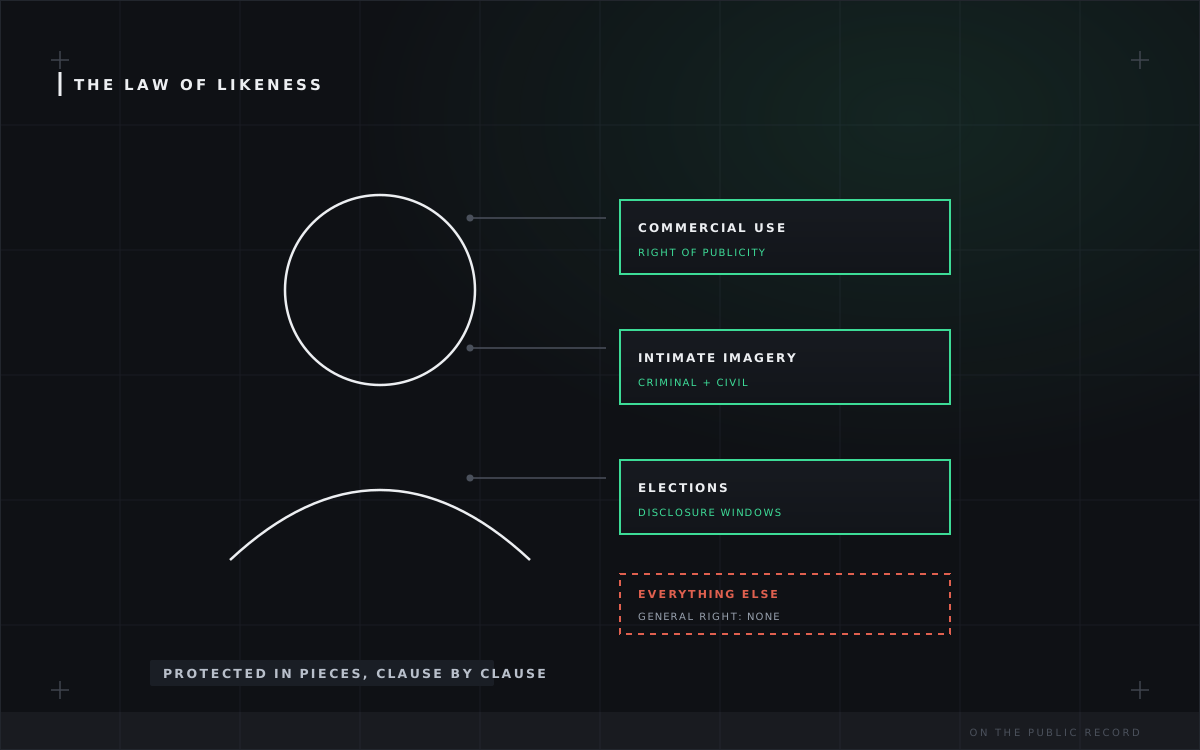
American law never granted a general right to your own face. What it grants, in mid-2026, is a rapidly assembled patchwork - one federal criminal statute, one civil bill through the Senate, one landmark voice law, and deepfake legislation in forty-six states - each covering a slice of the harm and none covering all of it. This brief maps the coverage, clause by clause.
46US states with deepfake laws enacted, spring 2026
48 hrsFederal takedown clock for intimate deepfakes
$25MLost by one firm to a single deepfaked video call, Jan 2024
The federal floor: TAKE IT DOWN
The first federal deepfake statute is Public Law 119-12, the TAKE IT DOWN Act, signed 19 May 2025 after a 409-2 House vote. It criminalises knowingly publishing non-consensual intimate depictions - explicitly including AI “digital forgeries” indistinguishable from authentic images - with penalties up to two years, three where minors are depicted, and threats criminalised alongside publication. Its second half is a platform duty: covered platforms had until 19 May 2026 to stand up a notice-and-removal process that takes reported images down within 48 hours, enforced by the FTC as an unfair or deceptive practice. The first conviction under the Act landed in April 2026. The statute’s limits are equally precise: it covers intimate imagery only, and it creates no private right to sue.
The civil layer arriving behind it
That last gap is what the DEFIANCE Act addresses - a federal civil action letting victims of sexually explicit deepfakes sue creators and knowing distributors, with statutory damages up to $150,000 and more where linked to stalking or assault. It passed the Senate by unanimous consent in January 2026 and awaits the House. And for likeness beyond the intimate context, the NO FAKES Act - a federal digital-replica right covering voice and visual likeness, with First Amendment carve-outs for news, parody and criticism - was advanced unanimously by Senate Judiciary on 18 June 2026. Notably, it would preempt future state replica laws while preserving those on the books before 2025, an explicit peace treaty with the states that got there first.
What the states built first
Three buckets, moving at three speeds. Intimate imagery: essentially national now, with 46 states plus the federal floor. Elections: thirty states require disclosure on AI-manipulated political content - and this is where courts push back hardest; a federal judge struck key provisions of California’s AB 2839 in August 2025 on First Amendment grounds, and platform challenges to similar laws continue, so disclosure mandates are surviving where outright bans are not. Voice and likeness: Tennessee’s ELVIS Act, effective 1 July 2024, was the first statute to make a voice itself a protected right against AI mimicry, and a dozen states have followed with publicity-right extensions; Washington and Pennsylvania added “forged digital likeness” crimes in 2025.
The pattern is unmistakable: the harms got protected in the order they got headlines - intimate imagery first, elections second, voices third, and everything else still waiting.
The gaps a careful reader should see
A non-intimate, non-electoral, non-commercial deepfake of a private person - the fake argument with a neighbour, the fabricated confession - still falls between statutes in most places, reachable only through defamation or harassment law built for other eras. Fraud is racing ahead of doctrine: the Arup case, where an employee wired $25 million after a video call with a deepfaked CFO and colleagues, was a preview of a category insurers are only now writing endorsements for. And every statute above regulates the publisher; the 2026 legislative wave, per the state-policy trackers, is turning toward the tools - generative platforms, hosts, payment processors - which is where the next constitutional fights will be.
THE DOCKET - DATES THIS DESK IS WATCHING
- NOWPlatform compliance with the 48-hour federal takedown duty, in force since 19 May 2026.
- 2026DEFIANCE in the House; NO FAKES on the Senate floor - the civil architecture, half-built.
- 2026Election-law appeals - how much deepfake disclosure the First Amendment permits, decided ahead of the midterms.
The Policy Desk reads legislation so you don’t have to - but this is journalism, not legal advice. For decisions that bind you, read the statute or ask a lawyer who has.