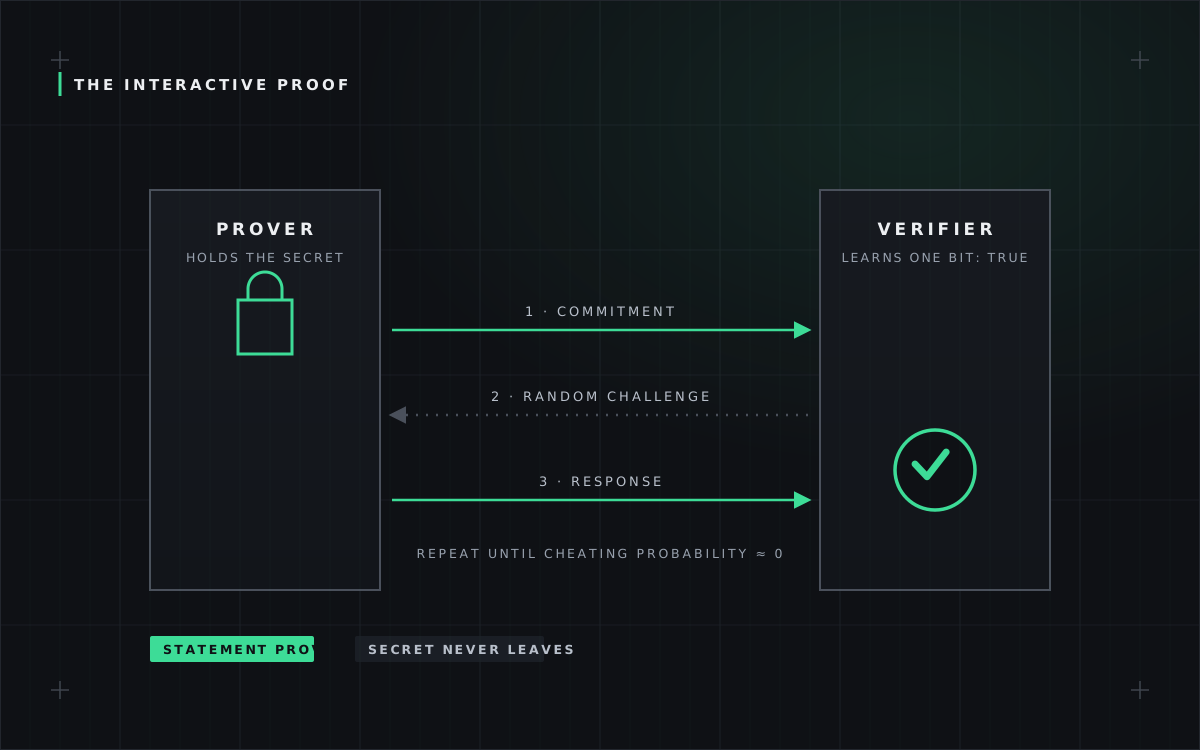
Here is the trick that makes everything else on this desk scale. A zero-knowledge proof convinces a verifier that a computation ran correctly. But verifying a proof is itself a computation - which means you can prove that too. Fold a thousand proofs into one, then that one into another: the work compounds, the final artefact stays small. Recursion sounds like a curiosity. In 2025 it became the reason a global blockchain can now be proven in real time.
The idea, taken slowly
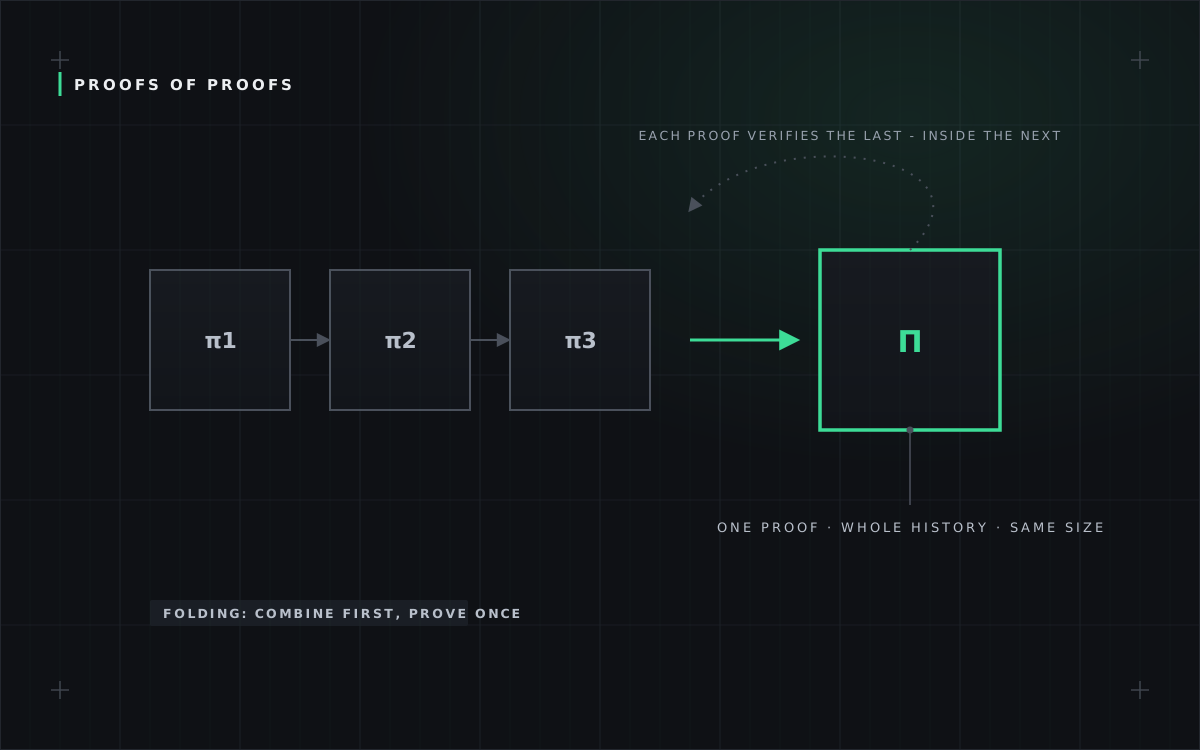
Picture a relay of accountants. The first audits a day of transactions and signs a one-page certificate. The second does not re-audit the day - she audits the certificate, plus her own day, and signs a new one-page certificate covering both. Repeat for a year: the final page vouches for everything, and checking it costs one page’s effort. That is recursion. Two engineering flavours dominate. Full recursion embeds a proof verifier inside the circuit being proven - expensive per step, maximally flexible. Folding schemes - the family that made the technique cheap - defer the expensive part: instead of verifying at each step, they combine claims into one accumulated claim, and prove only the final accumulation. Same destination, a fraction of the toll.
Why anyone bothers
Three payoffs. Parallelism: split a huge computation across a thousand provers, fold the results. Incremental verification: prove a long-running process - a whole chain’s history - as it grows, without restarting. And aggregation: many users’ proofs become one on-chain verification, amortising the cost that used to make verification the bottleneck.
2025: the year the numbers moved
At the start of 2025, proving a full Ethereum block - every transaction, every state change - took on the order of sixteen minutes. By the Ethereum Foundation’s year-end accounting, that figure was sixteen seconds, costs had fallen roughly forty-five-fold, and zkVMs were proving 99% of mainnet blocks in under ten seconds on target hardware. The public benchmarks tell the same story from the outside: one team’s zkVM reported proving 99.7% of blocks in under twelve seconds on sixteen consumer GPUs in early 2026; another hit an average of 6.9 seconds on sixty-four. Multiple independent zkVM implementations - a plurality mirroring Ethereum’s client diversity - converged on the same milestone. Recursion, folding, GPU-shaped provers and better commitment schemes did this together; none alone.
What real-time actually buys
The consequence is architectural, not incremental. If a block can be proven inside the block interval, validators no longer need to re-execute anything - they verify one compact proof, constant-time, regardless of what the block contained. That inversion is now formally on Ethereum’s roadmap: an L1 zkEVM design where proofs replace re-execution, with a proposed consensus change extending the proving window to a workable 6-9 seconds and a one-honest-prover liveness model. The stated destination is throughput measured in gigagas - roughly 10,000 transactions per second on the base layer - without asking every node to do the work.
THE PART A CAREFUL READER SHOULD NOT SKIP
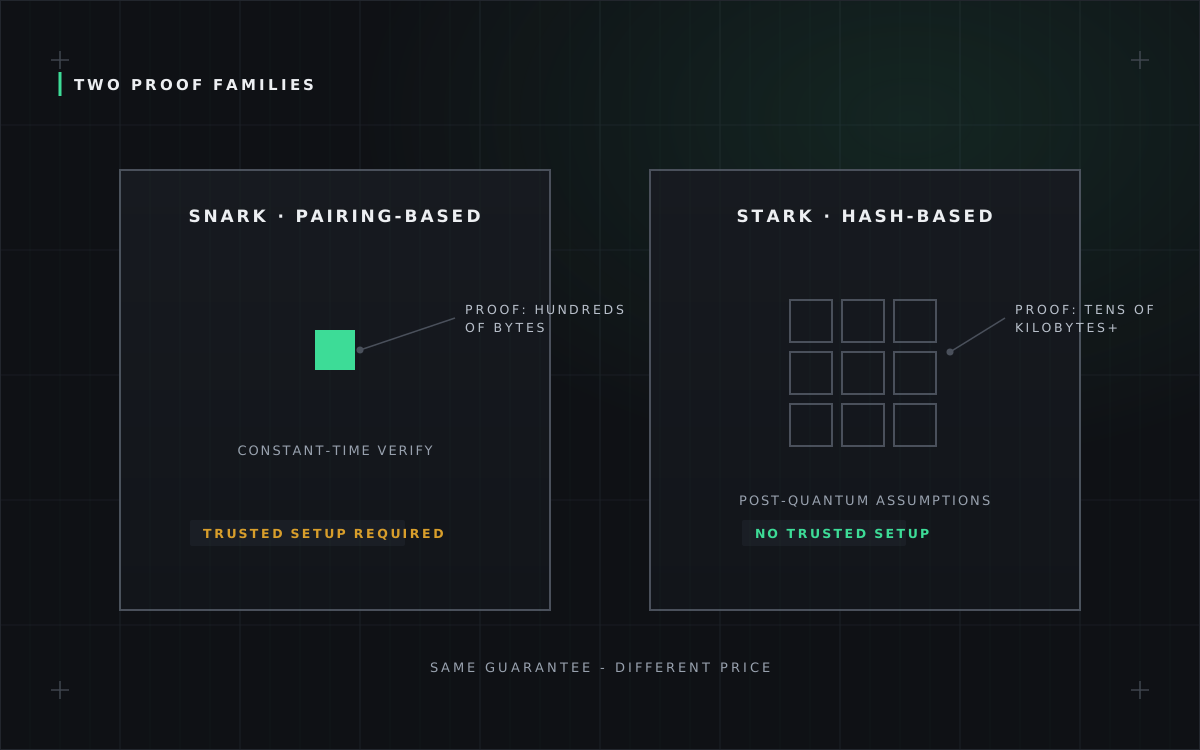
Speed arrived before certainty. The Foundation’s own 2026 framing calls security “the elephant in the room”: several fast proving systems lean on mathematical conjectures that recent research has begun to erode, and recursion compounds assumptions - a soundness gap anywhere in the tower is a gap everywhere. Hence the 2026 milestones this desk is tracking: 128-bit provable security, proofs at or under 300 kilobytes, and formal arguments for the recursion itself. Fast then sound is a reasonable order of operations only if the second half actually happens.
The desk’s summary
Recursion turned proof systems from artisanal - one proof, one computation, one wait - into industrial: proofs about proofs, assembled in parallel, verified in constant time. 2025 demonstrated the industry could hit the speed target early. 2026 will show whether it can hit the security target honestly. We will report both with the same enthusiasm.
GO DEEPER
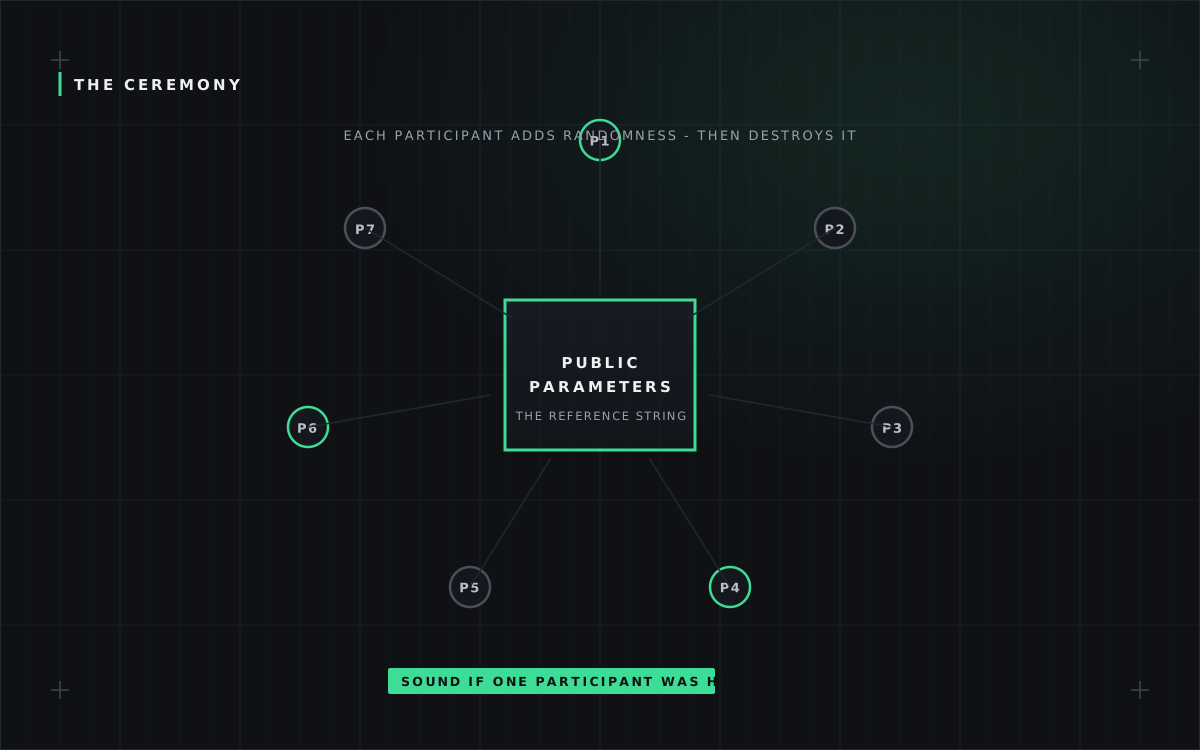
- The setup behind the speed - our explainer on trusted setups and the 141,416-contribution KZG ceremony.
- Reading the benchmarks - what “proves a block in X seconds” does and doesn’t claim.
- The base layer’s future - our rollup piece on where these proofs land on-chain.